
Home Blog Page 3

School Districts Play Fast And Loose with ‘Cost Per Student’ Metric

As Pennsylvania’s school districts approve budgets for the next year, talks about the ‘cost per student’ are frequent in school board meetings. Curious about its importance, I started looking into how it’s calculated, beginning with my local school district. Yet, the response from the district only raised more questions than answers, leading me to explore this topic further.

When people dive into school budgeting details, they often talk about figuring out the ‘cost per student.’ Even though this measure is important for making informed financial decisions, it’s not always clear how it’s calculated. People might wonder which budget items make up this figure.

Stakeholders often seek answers from important people in their school boards, like the board president or finance committee chairperson. But getting clear answers can be tough, as many people have experienced. Questions remain about which budget items are included in the calculation process and if there’s a standard method used by all districts.

Looking back at past board service experiences, understanding the cost-per-student calculation was always tricky. Despite repeated inquiries directed at district administrators, clarity on the matter remained elusive. The desire to undertake a logical approach, such as referencing enrollment figures reported to regulatory bodies like the Pennsylvania Department of Education, underscores the need for transparency and consistency in methodology.

Furthermore, considerations extend beyond the selection of line items to include in the calculation. Given the dynamic nature of student enrollment throughout the academic year, questions arise regarding the timing of cost-per-student assessments and adjustments.

In essence, unraveling the complexities surrounding the calculation of the cost-per-student metric illuminates broader discussions regarding accountability, transparency, and equitable resource allocation within educational systems. As stakeholders navigate these inquiries, the quest for clarity and standardization remains paramount in fostering informed decision-making and ensuring the optimal utilization of resources for the benefit of all students.

The board President said she would research the matter. She added “I know the account numbers change somewhat each year thanks to PDE. They probably do that to be sure no one can figure it out!” Is the formula altered by the PDE, or is it adjusted each year to align with specific narratives or agendas?

The new Business Administrator at UPSD replied “As far as what costs we use to determine per student cost, you are 100% correct that it is fluid. If I remember correctly, with the instructional cost-per-student earlier this year, I pulled the 1100 function from the budget and divided it by non-special education students. When the Finance Committee requested cost per student for special education students, I pulled the 1200 function and divided it by the number of special education students. Those are solid numbers, but not something that is reported to PDE.”

Follow-up inquiries were made, delving into the consistency of cost-per-student calculations across districts. Questions were raised regarding the existence of a standardized definition or formula guiding this process, particularly considering districts’ tendencies to compare themselves with neighboring counterparts. Concerns arose over the absence of uniformity, with suspicions confirmed that no such standardization exists. While the formula employed by UPSD seemed logical, comparisons with districts using different methods were akin to comparing apples to oranges.

In pursuit of greater clarity regarding the methodologies used by other districts in calculating instructional costs per student, several Right to Know requests were filed with several districts. The requests sought specific details about the formula utilized, including function codes and student enrollment figures, necessary for computing the total instructional cost per student. Furthermore, data spanning the last three school years was also requested to analyze and gain insight into any potential trends or fluctuations in instructional expenditures per student over time.

As anticipated, responses to the inquiries exhibited a range of attitudes and promptness. While certain districts promptly provided the requested information, others seemed to approach the matter with more caution, invoking the full 30-day period to process the request. Methacton school district, however, opted to deny the request outright, citing the absence of responsive records and invoking legal provisions exempting them from the obligation to create records that do not exist. Such varied responses underscore the complexities and nuances in navigating transparency and access to information within school districts.

Cheltenham School District requested more context as “there are variations to this calculation, so a little more context is required” and provided the following links for enrollment information [Enrollment Reports | Tuition Rates].

Following the initial request, additional clarification was provided to ensure specificity in the inquiry. Emphasizing the need for clarity, the specific details sought, including the function codes integral to cost-per-student calculations, alongside enrollment figures at the time of assessment. Furthermore, to facilitate comprehensive analysis, the period for data acquisition was outlined, spanning the last three complete school years: 2022/2023, 2021/2022, and 2020/2021. This additional clarification aimed to streamline the information-gathering process and ensure accuracy in comparative assessments across a designated period.

Despite the provided clarification, some districts continued to express resistance. Cheltenham SD, for instance, questioned the origin of the term “instructional cost per student,” suggesting it may not align with their internal documents. In response, clarification was offered, revealing the underlying intent of the inquiry: to ascertain the costs associated with student education, inclusive of all pertinent budget line items. This clarification aimed to simplify the request further, emphasizing the fundamental objective of understanding the total expenditure per student for educational purposes.

Lower Moreland SD provided a comprehensive response to the RTK inquiry, outlining their calculation method as the total budget divided by projected enrollment. This approach raised questions regarding the use of projected enrollment figures instead of the actual enrollment data reported to PDE. The use of projected figures could obscure transparency and verification of the cost per student, facilitating easier manipulation of the metric. Furthermore, the response shed light on the state’s role in calculating and approving elementary and secondary tuition rates, based on prior year actual data, and using a consistent formula across Pennsylvania public schools. This revelation prompted inquiries into the differences in cost-per-student calculation methods among districts, given the seemingly standardized tuition rate formula mandated by the state. The disparities in responses from various districts underscored the flexibility in approaches and interpretations. The districts’ responses varied as much as the formula used by the districts.

While Perkiomen Valley SD, Pottsgrove SD, Spring-Ford SD, and Souderton SD’s responses may not have fully addressed the inquiry, they nonetheless offered insights through the provision of the PDE-363 form for each of the three years under review. This form, titled “Calculation of Selected Expenditures Per Average Daily Membership,” serves as a tool for school districts in determining charter school rates. What’s intriguing is the existence of a designated form and formula for charter school rates, contrasting with the absence of a similar standard for public schools. The form comes complete with instructions for districts on how to report the information, shedding light on the systematic approach employed in the calculation process for charter school rates.

A surprising revelation emerges from the bottom of page 1 of the PDE-363 form: the Pennsylvania Department of Education (PDE) states that they will not verify the information provided by school districts in this document. This raises pertinent questions about the practice of self-certification by school districts when reporting data to the state. The need for such a disclaimer in the instructions prompts further inquiry into the underlying rationale behind this approach.

It’s worth researching if the formula used to calculate the cost per student for charter schools matches that of public school budgets. Likewise, scrutiny of the line items used in the data shows a lack of consistency, with differences observed across all districts. This unevenness extends to comparisons within the same district across different years, emphasizing the absence of standardized practices in cost-per-student calculations.

Souderton also stated “There are a few different per student cost calculations. There are the tuition rates calculated by PDE, and there are the Charter School per-student costs.”

Southern Lehigh’s response to the RTK request differed from others, as they provided a link to the Pennsylvania Department of Education’s (PDE) website instead of addressing the specific questions. The link led to the Annual Financial Report (AFR), which outlines the district’s revenue and expenditure accounts as mandated by PDE regulations. Their response was brief, providing an explanation of the AFR publication requirements and providing the PDE website for access to the document. AFR Data Detailed (pa.gov)

The link provided included a comprehensive account codebook, offering detailed explanations of revenue and expenditure codes, including the instructional and function codes. Furthermore, the Annual Financial Report (AFR) contains information on instructional costs per student. It’s important to note that AFR data is accessible for the fiscal year 2021-22 and prior; the PDE reviews and publishes new AFRs in the spring.

Boyertown ASD asked for my mailing address as part of the RTK request process, which was not required by other districts. Although this may appear unnecessary, I provided the information to proceed with the request. However, their response, consisting of a 67-page report detailing instructional function codes for the specified years, did not include information on the formula used to determine the cost per student or enrollment figures. This tactic aims to provide extensive documentation without offering specific answers, which can be frustrating for individuals seeking clarity. Such an approach overwhelms requestors with information, deterring further inquiries.

The Colonial School District provided a large document, including the last three years of PDE 2057 reports spanning 462 pages, which detail their final self-certified budget submissions required by PDE. They also provided tuition rates submitted to PDE and enrollment figures. However, they didn’t include the formula used to determine these rates or specify the line-item function codes contributing to the tuition rates.

Abington School District’s response was notable in that they supplied Section 2561 of the 1949 school code, which was amended in June 1997. This section explains how tuition charges are calculated when a district educates a student from another district. It says the district needs to figure out the tuition charges for non-resident students at the beginning of each school year, based on expenses from the previous year.

The Abington School District also shared their tuition rates from the PDE Annual Financial Report, along with their enrollment numbers.

The Lower Merion School District’s response was especially disappointing. They just sent a link to the PDE tuition rate page and told me to ask the state for more information. This feels like they’re avoiding responsibility and shifting blame just like a politician. Also, stating they’ve answered the request when they haven’t just made the experience more frustrating.

As we investigated how ‘cost per student’ is calculated, it became clear that transparency and consistency are problems in Pennsylvania’s school districts. Some responses gave helpful information, but others didn’t give enough clarity. The different responses, from really detailed to avoiding the question, show how hard it is to obtain clear information.

The lack of standardized methods for calculating cost-per-student makes it impossible to compare schools and make informed decisions. Plus, schools certify their own data without oversight. How reliable is the data? There is a need for more accountability and standardization in how cost-per-student is calculated.

In the future, policymakers, educators, and community members need to push for clearer and more consistent school budgeting. This means setting up clear rules for calculating ‘cost per student’ and ways to audit the data. By making transparency and accountability a priority, Pennsylvania’s schools can better meet the needs of all students and make sure resources are distributed fairly across districts.


Appreciate what you’re reading? Be sure to share it!

Have a story? Break it at LibertyLens.News! Become a Contributor.

Support platforms, like The Liberty Lens, that enable independent grassroots journalism. Donate here.


DEI: Division, Exclusion, Indoctrination has NO Business in K-12 School Districts

DEI has no place in any School District. It does not stand for Diversity, Equity, and Inclusion, but for Division, Exclusion, and Indoctrination. It’s wielded as a weapon by those prioritizing equity over achievement. How convenient to sugarcoat a flawed system with feel-good language.

While diversity can enrich communities, DEI initiatives often fixate on race, sexual orientation, and gender, oversimplifying complex identities and confusing children.

Equity should ensure fairness and justice, addressing systemic barriers and providing opportunities for all to succeed. But DEI aims for equality of outcome, holding children back instead of fostering achievement.

Inclusion should create welcoming, empowering environments. But DEI promotes conformity, stifling dissenting views and bullying those who differ into silence. That’s not inclusivity.

Amplify is a left-wing educational curriculum with the potential to influence and shape young minds. This is the company that UPSD wants to spend $238k for K-5th grade curriculum.  That’s a lot of money for an initiative that is being banned from other organizations.  Legislators across the country are putting forth bills to ban DEI programs.  Why is UPSD implementing this now?  UPSD should be investing in proven educational material, not politically motivated indoctrination. Our children deserve better. They are not political pawns.

— Raeann Hofkin, Palm, PA


Appreciate what you’re reading? Be sure to share it!

Have a story? Break it at LibertyLens.News! Become a Contributor.

Support platforms, like The Liberty Lens, that enable independent grassroots journalism. Donate here.



IX is for XX

New Title IX rules from the Biden administration now protect ‘gender identity’. This means that students can face discipline or embarrassment if they use pronouns or descriptions based on a person’s birth gender – especially if that person identifies differently. Moms for Liberty is fighting these changes with a lawsuit along with Kansas, Alaska, Utah, Wyoming, and the Young America Foundation. Moms for Liberty says these rules could stop students from expressing discomfort with someone of the opposite sex in their bathroom and could prevent parents from teaching their children about gender identity according to their own beliefs.

The Title IX Law reads:

“No person in the United States shall, on the basis of sex, be excluded from participation in, be denied the benefits of, or be subjected to discrimination under any educational program or activity receiving Federal financial assistance.”

Just thirty-seven words. Signed into law by President Richard Nixon in June 1972. Title IX is a variation of the Civil Rights Act of 1964. Instead of ‘race, color, or national origin’ they substituted the phrase for the word ‘sex.’ The women who helped draft the legislation were looking for a level playing field in academics. Over the last 50 years, it has morphed into more opportunities for (biological) women on and off the sports field.

Title IX regulates every public school, college, and university prohibiting discrimination ‘based on sex.’  On July 12th, 2022, the Department of Education decided to rewrite the regulations that implement Title IX to expand the scope to include sexual orientation and gender identity. Fast forward to 2024 and the word “sex” is about to destroy the progress made over the last 50-plus years. In the name of progress, of course.

This change to the regulations will have devastating consequences on parental rights. The new regulations would normalize gender confusion harming the children’s health by requiring schools to support transitioning children without requiring notice to parents. These rules will increase calls to child protective services for parents who uphold biological reality.

This change will have devastating consequences on First Amendment rights as school districts will be forced to adopt clown world policies and play make-believe. Heck, some schools are already enforcing the change and the law has NOT been passed. If it passes, it will restrict students and teachers from speaking freely and treating others in a biologically accurate manner based on reality.

After the US Department of Education put the change on hold in May 2023, and again in October 2023, it has finally moved forward, and the rules are set to be rolled out in August 2024. Why are school districts making changes as if it were already the law? Know your rights, know the law, and push back. Just because they say it is, doesn’t make it so.

With this change to Title IX, forget about girls’ privacy and safety as the schools would be required to open their bathrooms and locker rooms to students according to their gender identity. Girls/women will be forced to surrender their right to privacy and be placed at an increased risk for assault by males claiming to be females.

Say goodbye to sports opportunities which include sports scholarships. Girls/women will be forced to compete for scholarships and athletic opportunities against biological males claiming they feel like a woman.

This change will create a new regulation based on “sex discrimination” defined as sexual orientation and gender identity. The new regulations would make biological reality a form of sex-based harassment. Schools would be mandated to promote gender identity ideology and everyone else will be forced to suck it up and pretend it’s normal.

As if that’s not bad enough, the change in regulations would turn the school official known as the Title IX Coordinator, into a federal law enforcement official. This means the new regulations would give the Title IX coordinator new authority to enforce the new mandates. Do you know your school district Title IX coordinator? Would he/she contact Child Protective Services because the parent refuses to play make-believe?

You may be wondering how or why the school districts would comply before the legal challenges work their way through the courts. School districts are being threatened that if they don’t comply, their free/reduced lunch program will be defunded. In other words, the federal government is willing to starve the children if the school district doesn’t comply with the changes.

The potential implications of these changes are concerning. This change takes away parents’ basic rights to guide their child’s upbringing. Parents should always be kept informed, especially about things that affect their child’s well-being and education. Parents must be fully included in decisions about their children’s schooling. Any policy changes must be clear, respect parents’ rights, and benefit ALL students.

For more information, go to https://www.momsforliberty.org/title9/ to learn more about how you can help protect women.


Appreciate what you’re reading? Be sure to share it!

Have a story? Break it at LibertyLens.News! Become a Contributor.

Support platforms, like The Liberty Lens, that enable independent grassroots journalism. Donate here.
Become A Precinct Committeeman

By becoming a Republican Committeeman for your local county or State Republican Party, you can vote on County bylaws and help elect better county and state party leadership of the republican party and local county GOP. Plus, get out the vote for better MAGA and America First candidates to get on the ballot and get more republican voters to your very own voting precinct and change the republican party from inside the party by recruiting more precinct committeeman to the republican party to outnumber the moderates in the republican party. No precinct committeeman? No republican party. It’s that simple. There are over 200,000 empty precinct committee seats in the Republican party that need to be filled. If you need more information on becoming a precinct committeeman, go to Dan Schultz’ website PrecinctStrategy.com. The Precinct Committeeman is the most powerful office in the country because we help get the candidates on to the primary ballot and endorse candidates and can even primary candidates off the ballot. Plus, we elect leadership all the way up to the RNC Chair.

— Steven Carr, Glen Rock, PA


Appreciate what you’re reading? Be sure to share it!

Have a story? Break it at LibertyLens.News! Become a Contributor.

Support platforms like The Liberty Lens that enable independent grassroots journalism.

Albert on The Job? Cybercriminals Seize Control of A Pennsylvania County’s Network

In Washington County, Pennsylvania, foreign cybercriminals were able to seize control of the county’s network, basically paralyzing all of the county’s operations. The cyber-attack became a full-blown ransomware attack that resulted in a ransomware payment of nearly $350,000. According to the March 15 WJPA News Archive, the Commissioners indicated that prior to their being notified of the attack, the cyber criminals took data from the county’s network that contained personally identifiable information. It is interesting that Washington County had an Intrusion Detection (Albert Sensor) Service Agreement with the Pennsylvania Department of State which provided network monitoring. So, did Albert perform as expected?

What is an Albert Sensor? What part does Albert play when a county experiences a cyber-attack? And more broadly, what part does Albert play in Pennsylvania’s elections? Much has been written about Albert Sensors. Much is still unknown. According to CIS, Center for Internet Security, Albert Network Monitoring and Management is an industry-leading Intrusion Detection System (IDS) designed specifically for U.S. State, Local, Tribal, and Territorial (SLTT) government organizations. Albert Sensors reportedly help states and counties by monitoring for malicious traffic, serving as a second line of defense, offering 24x7x365 management and support, saving money with free incident response, serving as an extension of the security team, and has a Net Flow Record.

During the last days of the Obama Administration, our elections became part of the Federal Government’s critical infrastructure. This was accomplished under the Department of Homeland Security (DHS). At this time, it was alleged that Russia hacked into the 2016 election and changed the outcome of the Presidential race. On January 6, 2017, Homeland Security Secretary Jeh Johnson released a statement explaining that by election infrastructure, we mean storage facilities, polling places, and centralized vote tabulations locations used to support the election process, and information and communications technology to include voter registration databases, voting machines, and other systems to manage the election process and report and display results on behalf of state and local governments. The Department of Homeland Security partnered with the Center for Internet Security (CIS), a Non-Governmental Organization (NGO).

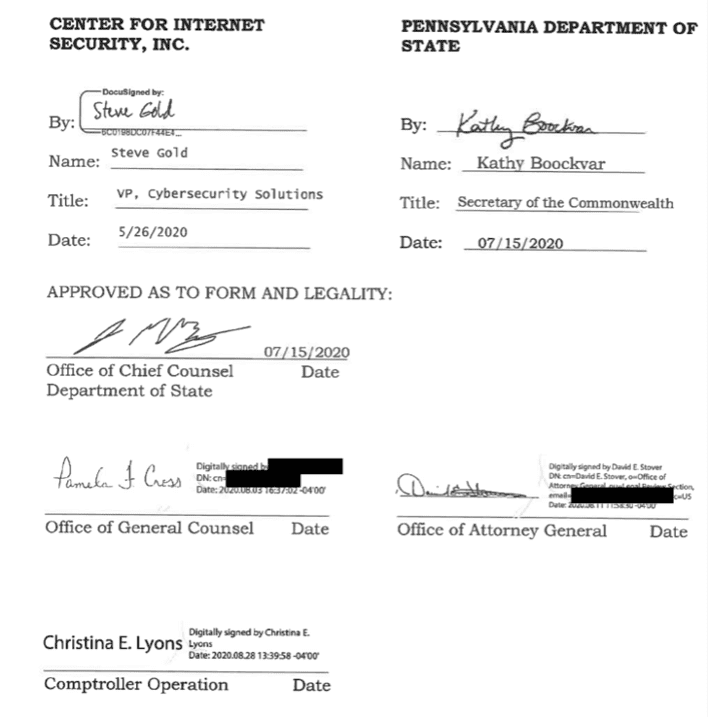
On July 15, 2020, Secretary of the Commonwealth of Pennsylvania, Kathy Boockvar, entered into a Service Agreement for Albert Monitoring Services with the Center for Internet Security (CIS).

Albert Image 1
Figure 1. Signatories on PA’s Service Agreement for Albert Sensor Monitoring. (Click to enlarge.)

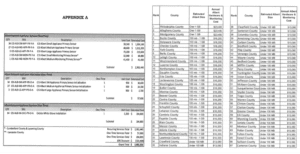
Appendix A of the service agreement includes the Albert Network Appliance Services needed for the 67 counties in Pennsylvania as well as the costs for each of Pennsylvania’s counties. Under the agreement, CIS would receive $2.9 million to monitor the entire state of Pennsylvania.

Albert Image 2
Figure 2. Excerpt from Appendix A of Albert Service Agreement

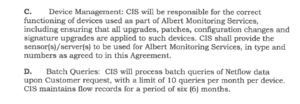
Appendix B of the service agreement includes Device Management and Batch Queries. Small, medium, and large appliance sensors are proposed for the various counties. The actual specifications for the equipment being installed appears to be a mystery. The fact that CIS has not disclosed anything about the actual equipment being installed is cause for alarm because this equipment is being installed behind county firewalls. Pennsylvania citizens deserve to know what the capabilities and vulnerabilities of this equipment might be.

Albert Image 3
Figure 3. Excerpt from Appendix B of Albert Service Agreement

Before providing Albert Sensor Services to a county, the county would sign a contract or a Memorandum of Agreement (MOA) with the Pennsylvania Department of State. Other states who have examined their Albert Sensor MOAs found a disturbing clause in requiring every employee who worked on the network being monitored to give up their expectation of privacy for their data. However, the Memorandum of Agreement with Pennsylvania Counties appears to be missing this clause, but other language in the MOA suggests that CIS does indeed have the same expansive access to the election system being monitored.

The following information came from a Memorandum of Agreement between a Pennsylvania County and the Pennsylvania Department of State. MOAs with other Pennsylvania Counties look the same.

Services Provided

  • Combined NetFlow and intrusion detection system monitoring, with analysis of related data; event notification and delivery; and management of associated devices, including hardware and software necessary for service delivery.
  • Security Operation Center (“SOC”)- 24 X 7 X 365 watch and warning center operated by CIS that provides network monitoring, dissemination of cyber threat warnings and vulnerability identification and mitigation recommendations.

County Responsibilities

The County has several responsibilities that must be afforded to the PA Department of State and the Center for Internet Security (CIS) prior to commencement of services. Albert Network Monitoring and Management is an Intrusion Detection System. This intrusion into the county’s election infrastructure is alarming. Counties give up both internet access and expansive access into all aspects of their election infrastructure to the Center for Internet Security who is partnered with the Department of Homeland Security. Furthermore, upon entering into an Albert Monitoring agreement, the county gives the Elections Infrastructure Sharing and Analysis Center (EI-ISAC) total access to the Local County IP-Connected equipment. EI-ISAC is in the same physical location as CIS.

The County shall provide logistic support in the form of rack space, electricity, Internet connectivity, and any other infrastructure necessary to support communications at County’s expense. The County must supply current network diagrams to facilitate analysis of security events, other reasonable assistance to CIS, including, but not limited to, providing all technical information related to the Service reasonably requested by CIS, to enable CIS to perform the Albert Monitoring Service for the benefit of County. Public and private IP address ranges including a list of servers being monitored including the type, operating system, and configuration information, as well as a list of IP ranges and addresses that are not in use by County (Dark Net space) is required. A Pre-Installation and an Escalation Procedure Form is completed. The Escalation Procedure Form includes the name, e-mail address, and 24/7 contact information for all designated Points of Contact.  In addition, the County may need to furnish assistance with remotely installing and troubleshooting devices including hardware and communications.

Pennsylvania Department of State Responsibilities

Compare the PA Department of State’s responsibilities with the county’s responsibilities.  As consideration for the Services provided to County, DOS has agreed to pay to CIS the costs for such Services as set forth in the Agreement for the term of the Agreement. That’s all folks!

Moreover, one of the most surprising clauses in the Memorandum of Agreement is that the PA Department of State takes absolutely no responsibility that its monitoring system will be accurate or that it will even work as advertised! The No Warranty Clause of the MOA states that the DOS and its employees provide no warranty or assurances as to the accuracy or viability of the services provided by CIS. Would you sign a contract or do business with a company like that?

How to Begin An Investigation in Your County

Citizens might expect that an election infrastructure, intrusion detection system would have the approval of elected officials with the full knowledge and consent of the electorate. Citizens might want proof that there was an independent analysis conducted. Citizens might also want to know if Albert Sensors are co-located with registration databases such as electronic poll books. County Commissioners, Directors of Voter Services, and County Clerks may not even know what an Albert Sensor is. However, the County Chief Information Officer or the Information Technology Director appears to be the main contact person in each PA County. Citizens can begin their investigation into whether Albert Sensors are in their counties by doing the following:

  1. Search County Commissioners’ Meetings agendas. Check the county government website. Some agendas can be found online. Use these search words: Albert Sensor, Memorandum of Agreement for Albert Sensor Services, Pennsylvania Emergency Management Agency (PEMA) funding Cybersecurity (Albert Sensors)
  2. File these Right to Know Requests regarding agreements between the county and the PA Department of State:
  • I am requesting a copy of the Albert Sensor Memorandum of Agreement (MOA) for Services between the Pennsylvania Department of State (DOS) and the County of NAME. I prefer electronic documents.
  • I am requesting the Consent Agreement with NAME County and the Commonwealth of Pennsylvania through the Pennsylvania Emergency Management Agency (PEMA) for funding Cybersecurity (Albert Sensors) from Fiscal Year 2022 State and Local Cybersecurity Grant Program (SLCGP). I prefer electronic documents.
  1. File this Right to Know Request regarding communications between the County Commissioners Association of Pennsylvania and the county:

    I am requesting communications between NAME County and Michael Sage, Chief Information Officer of the County Commissioners Association of PA between the dates of January 1, 2020 to present. Records requested may be located with NAME: Chief Information Officer at the Department of Information Services, or within the department or NAME: Information Technology Director, or within the I prefer electronic documents.

Albert Sensors have been deployed throughout the state of Pennsylvania. Citizens should conduct their own research to find out if Albert is being implemented in their county and what expectation does their county officials have regarding Albert. In addition to Washington County, Bucks and Butler Counties encountered cyber-attacks this year. Those counties also have Albert Sensors. Albert does not actually stop a cyber-attack but only monitors for malicious traffic, serves as a second line of defense, offers 24x7x365 management and support, and saves money with free incident response. Did Albert perform as expected in Washington, Bucks, and Butler Counties? One might ask, what else does Albert monitor regarding election infrastructure? That is a question that remains unanswered.


Appreciate what you’re reading? Be sure to share it!

Have a story? Break it at LibertyLens.News! Become a Contributor.

Support platforms, like The Liberty Lens, that enable independent grassroots journalism. Donate here.
 

Students Taking Candy from Strangers – Or Rather, Kooth Employees

As if Kooth wasn’t bad enough for Pennsylvania students, recent developments have shown the mental health platform in an even worse light. Late in February 2024, Wyoming Area School District (one of the first districts to sign up for Kooth) hosted an assembly presented by Kooth representatives. The following week, on February 27, 2024, parents at Wyoming Area School Board meeting claimed that Kooth representatives were enticing students to sign up for Kooth by handing out candy, cookies, and stickers (see minute mark 31:00). Students were even told by Kooth representatives that they did not have to tell their parents, according to angry parents at the board meeting. Kooth representatives had conveniently been invited to join the school board meeting.

Why would a school district allow this? They allowed representatives of a third party to come into school and give kids candy to entice them to do what they wanted. Not okay! Can the administration be trusted?

Why would Kooth do this? If you listen to the board meeting, Kooth representatives denied handing out candy to entice students, and said there was a technological issue due to too many logins, and that candy was later passed out in the classrooms for their inconvenience. The Kooth representative(s) were escorted by school employees from classroom to classroom. One parent asked how they anticipated such an issue and how they were prepared with that amount of candy (excellent catch!). Another parent pointed out that Kooth’s stocks were down over 60% over the last 6 months. Was Kooth incentivizing students to sign up and log in to inflate their statistics for investors?

Parents, it is time to reiterate to your children, no matter their age, that they should never accept candy from a stranger, even if that stranger is at school. We teach our children not to accept rides, even from parents they know, unless we give them permission. And here is an example of a school district going behind our backs to undo lessons that we as parents have instilled in them.

Representative Cabell, who is being challenged this primary by Jamie Walsh, finally took a stance on Kooth’s overreach at WASD and in the near future will be introducing legislation “that prohibits mental health services that contract with school districts from distributing prizes for signing up for a service.” Representative Cabell has also recently signed onto Representative Scialabba’s bills meant to reign in programs like Kooth. Previously, he had been supporting Kooth in schools. “What changed?” you might ask. I’ll tell you what has changed: Jamie Walsh has challenged Cabell’s stance on parental rights and his promotion of Kooth. In a recent debate between the two candidates, Jamie Walsh called out Representative Cabell for owning 8% as a shareholder in Elium Health and sitting on the board of directors. Elium Health is in the Greater Philadelphia Area and their website advertises “psychiatry + medication in-person & virtual appointments in Pennsylvania for ages 14+ appointments available within 48 hours.” No conflict of interest there, right? The truth is that Kooth could feed Cabell’s investment through referrals. With minor consent laws allowing children ages 14 and up to consent to mental health services, this company, like Kooth, can take advantage of impressionable teens who can consent to services without their parents’ knowledge. After Representative Cabell was called out at the debate, he asked for a mother to stop recording, despite the event being held in a public place. (First amendment rights generally allow for recording when the matter is of public interest and held in a public place.) If that wasn’t unflattering enough, Jamie Walsh also announcedthat Representative Cabell’s campaign manager attempted to bribe Jamie not to run this time around with a $10k check and instead run in 2026 for Senator Baker’s seat when she retires.

Since the debate, I’ve discovered that Representative Cabell also has 5.9% shareholder in CIVIQ, which appears to be an Addiction & Behavioral Health Center. As of November 2021, it also appears that they joined forces with Odyssey Behavioral Health. (Note the LGBTQIA+ flag at the bottom of both websites.)

If that isn’t interesting enough, remember from my previous article that we discovered Senator Baker’s son, Carson Baker, was lobbying for the DT Firm and lobbying specifically for Kooth? He has now been removed, as of February 15, 2024. Just days after Jamie’s debate with Representative Cabell, Elium Health discontinued their business with the DT Firm. Yes, Elium Health was using the same lobbying firm as Kooth. It appears that everyone is cleaning house now.

What’s Around the Corner for PA Students?

Recently, Representative Schlossberg (D) released a memo to pilot another program, this time a “school behavioral health screening pilot program”. The memo states:

“Our schools need the tools to help to identify children and teenagers who are struggling, and help those kids get the help they deserve – before it is too late. That’s why I will be introducing legislation establishing a pilot program to implement annual mental health screenings for students in grades six through twelve. Considering the success seen in similar programs across the country, this bill will require the Pennsylvania Department of Education to assess the needs of each school district and their progress in establishing the community health infrastructure necessary to screen their students. Finally, this legislation will direct grant funding to help districts bring on additional staff, expand their current programs, and work more closely with other community resources to accommodate the expected increase in students identified with mental health diagnoses.” 

On March 12, 2024, Senator Comitta (D) and Senator Rosemary Brown (R) released a similar memo but calling it “school mental health screening pilot program” and noting there would be a parental opt-out if desired.

This is where we are headed – mental health screenings for every Pennsylvanian student. We as parents need to be shouting from the rooftops that we do not want this! This program needs to be changed to an opt-in program, not an opt-out program. Opt-in programs allow for more parental permission and control, whereas opt-out programs are often set up with parents being unaware that they can opt out, or that the program is even happening.

Embedding Mental Health Centers in Schools

In January 2024, three House Education committee hearings were held by Representative Schweyer (D). (1-3) In these hearings, schools and mental health providers were pushing to discontinue the use of county behavioral health services in schools and allow schools to bring in “school based mental health centers”. They want a one-stop shop, purportedly for continuity of care, where parents cannot see what is happening.

Schools want to tap into federal tax dollars that they would receive from Medicaid. Every child with a plan of care (POC) would be billable to Medicaid and therefore, money that the school would receive. Can you imagine the money to be made? The more students who have a mental health diagnosis and a POC, the more money for school districts. This is a built-in incentive to have a high population of students with a mental health diagnosis!

In May 2023, the Biden Harris administration, through the Department of Education announced they would be proposing a new rule that would streamline services, especially mental health services. They proposed that school districts would no longer need to get parental consent to bill Medicaid. In the release above, they say how crucial it is to remove barriers so schools may easily provide Medicaid covered services. WHAT?! Parental consent is now considered a barrier to providing services? How can anyone ethically bypass informed consent? Who is consenting on behalf of a minor child? The school district, who has hired or contracted these providers? Or, is it the government?

Parents Question the System

According to this article in Education Week, “in a December 2022 AASA survey of administrators, 70 percent said there is a generalized concern among parents about signing any Medicaid consent or release form.” Parents expressed concerns “that their financial situations would become publicly known or there would be strings attached to the Medicaid billing.” So, this is the real barrier, too many parents questioning the system. As patients, when we walk into a medical facility for the first time and sometimes every time, we sign a financial agreement and a consent to treat. How is this any different?

As far as I can tell, removing parental consent to bill Medicaid in schools has not yet been implemented. For those who don’t have a special needs child, parents are asked for consent to bill Medicaid at IEP meetings. An IEP meeting is required to begin services and they are required yearly by law but may happen more frequently if requested. Will there be a push to eliminate IEP meetings? Where does this go from here? The clear trend is that the government is attempting to push parents out of the picture.

What might not be obvious at first is that school-based health centers and/or school-based mental health centers will not only provide mental health services, but they will also diagnose, treat for various conditions, and potentially even administer vaccines. The possibilities continue: they could prescribe SSRIs or anxiety medications, and parents would have no idea, thanks to our minor consent laws and the general consent form parents sign at the beginning of the school year. That mental health diagnosis could permanently stay on your child’s school record and medical record. Could this prevent your child from entering the military, getting certain jobs, or owning a gun? Could it prevent parents from owning guns if their child has a mental health diagnosis? I believe this is where we may be headed.

Since things have mostly returned to “normal” after COVID, many advocates have gone inactive. In fact, some freedom groups have disbanded. Many are not aware of the new and impending developments surrounding school-based clinics. We need citizen advocates to stay vigilant and to look to the future to realize the full implications of new programs.

Kooth is bound to disguise itself as something else. Maybe if their current model fails here, they will be the company to perform mental health screenings on PA students. Who knows! But the push is strong for school-based services. Companies like Effective School Solutions and Gaggle already exist. It is imperative as parents that we know what is going on in our school district. Currently, Pennsylvania School Based Health Alliance has 30 school-based health centers listed in Pennsylvania, mostly centralized in Philadelphia.

The NHS is now investigating Kooth for its “pro-trans” website just a week or so after the NHS in Englanddecided to make puberty blockers less available to minors due to the lack of scientific evidence. Some countries, such as Norway, Sweden, and the Netherlands, are starting to realize the lack of scientific evidence for certain procedures, and understand the harm can happen when we allow experimental procedures on minors. However, here in America, it seems that quick fixes are enticing, and the system encourages doing “something” over finding root causes. As with anything else in healthcare, if they fixed the root cause, there would be little money to be made by Big pHARMa, by politicians who have conflicts of interest, by insurance companies, or healthcare systems. We must break free of this corrupt system!


Appreciate what you’re reading? Be sure to share it!

Have a story? Break it at LibertyLens.News! Become a Contributor.

Support platforms, like The Liberty Lens, that enable independent grassroots journalism. Donate here.
 

Food Freedom? Government Says, NO! Americans Say YES! Part 2

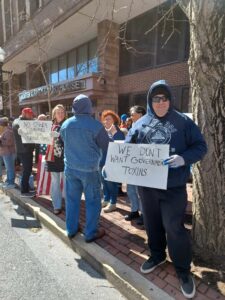
Food freedom - stand against tyrannyOn February 29, 2024, Americans rallied in front of the Lancaster County Courthouse to support Pennsylvania organic farmer, Amos Miller, who has been providing farm fresh food to members of a private association for over a decade.

The rally’s program included speeches from: Peggy Buhalo, president and co-founder of Patriots for Pennsylvania, Chris Hume of The Lancaster Patriot, Pastor Joel Saint, Sally Fallon Morrell, creator of realmilk.com, Morgan Phelps, who runs a raw milk business and was mentored by Amos Miller, Max Kane, a reporter for The Highwire, Sam Faddis, a leader of a PA Patriot Coalition, and “James”, a health coach who eats all of his food raw.  See the full speeches here.

Peggy Buhalo is concerned about the corruption of our justice system and the attacks on our food supply. She is the president of Patriots for Pennsylvania. She said, “We cannot turn a blind eye to the injustice that is being brought against Mr. Miller and his family. This is a massive government overreach and it jeopardizes the freedoms that our forefathers set in place for us.”

We Don't Want Government Toxins

Chris Hume believes our government wants to control every aspect of our lives. He attended the rally as a speaker, but he is known for being the Editor of The Lancaster Patriot. Chris stated, “This has been a long time coming, to let the State know that we don’t need them to tell us what we can eat. Am I right? (Crowd Cheers.) The State wants to control everything about your life. They want to tell you what you can eat or what you can drink. It does not end with Amos Miller. They are coming after each and every one of us. They want control. Amos Miller is the tip of the spear here when it comes to Freedom. If we don’t have the freedom to decide what we eat, what we feed our families with, what freedom do we have?”

Selling Raw Milk Products

Mr. Miller is not allowed to sell any raw milk products to members in PA. He is allowed to sell other food items such as beef, buffalo, poultry and baked goods. Judge Sponaugle’s April 12 ruling allows Mr. Miller to sell his raw milk products to anyone who resides outside the Commonwealth.

There has never been a food recalled from Mr. Miller’s farm. Even though there has been over a dozen big food processor products recalled since Mr. Miller’s case started, the PA Department of Agriculture (PDA) has not conducted search warrants or raids on these food processors. When Mr. Miller was raided people were prevented from watching the search, including a member of the press. Mr. Barnes is requesting a copy of the police body cam footage from the raid on Mr. Miller’s farm.

If Mr. Miller obtained a raw milk permit he would be prohibited from selling most of his raw milk products. The permit only allows the sale of raw milk and raw hard cheese. Mr. Miller makes raw butter, colostrum, butter, yogurt smoothies and more. These products are consumed by members who claim it benefits their health. Mr. Barnes stated Mr. Miller’s case is focused on informed consent – being allowed to make an informed decision on what food products you consume. He does see how some people may view this case as a way to limit government control, which is important too.

Mr. Barnes asked, “Did you know if you go to the hospital sick and if they suspect it is a food borne illness, your medical records are handed over to government agencies? I don’t remember consenting to that – so much for privacy or medical autonomy.”

Legal Implications

The Amish don’t believe in suing. Mr. Barnes said, “PDA thought they could get away with it – not realizing they were violating other people’s constitutional interests.”  If you suffer monetary damages against the State, you will not be reimbursed for them because the State is immune to paying out monetary damages.

Mr. Barnes filed a petition challenging the food destruction order. This order would force Mr. Miller to destroy his inventory, which would hurt him financially, and it would deny members products they wish to consume. The order cannot be enforced until the court rules on the petition. Mr. Barnes feels the order is unlawful because none of Mr. Miller’s products have proven to be unfit for human consumption.

Those who attended the February 29 court proceeding were prevented from keeping their notes.  The shepherdess stated a sheriff went around collecting all written notes taken during the proceeding.  Mr. Barnes said this is illegal. He thinks the PA Courts like to keep proceedings secretive, which is inconsistent with our first amendment. Pennsylvania is supposed to have open courts. Mr Barnes thinks it would have been good if the public could have seen the court proceedings live, especially PDA’s witnesses.

The following have been filed with the Courts: a motion to stay injunction, a notice of appeal, a petition to fight the food destruction order, and a federal civil rights claim.

Robert Barnes, Attorney for Amos Miller, was interviewed by independent journalist, the Shepherdess. She has given written permission for The Liberty Lens to publish the interview. Watch the full interview:

Citizens are helping with Amos Miller’s defense through a fundraiser at GiveSendGo .

  • Free America Law Center – co-founded by Mr. Barnes – currently focusing on Amos’ case.
  • Sign up for Mr. Miller’s membership; purchase products he is allowed to sell.

Stay tuned… The rest of the Amos Miller series will be released soon:

  • Part 3: Customer Testimonials
  • Part 4: Interview with the Food Freedom Rally organizer

Appreciate what you’re reading? Be sure to share it!

Have a story? Break it at LibertyLens.News! Become a Contributor.

Support platforms, like The Liberty Lens, that enable independent grassroots journalism. Donate here.


How Pennsylvania GOP Legislators Put Businesses and Big Tech Over Our Children’s Mental Health

SB22 was introduced June 14, 2023, by Senator Vincent Hughes and was referred to the Communications & Technology Committee with bipartisan support. The bill as originally written aimed to protect minors and their mental health from social media. SB22 received bipartisan support and had a full range of cosponsors, which is rare in Harrisburg. The original bill would have encompassed many social media applications. It also required a parent to approve a minor’s social media account.

However, SB22 was amended on September 19, 2023, prior to passing out of committee. The amendment changed the previous definition of a social media company, knocking out most platforms, but still including approximately 10 platforms, one being Facebook.

In the original bill, SB22 allowed parents to sue a social media company that “intentionally, knowingly, recklessly or negligently causes or encourages a minor to access content which subjects the minor to a risk of emotional or physical harm…”. But again, this was amended, handing jurisdiction over to the PA Attorney General. In the event that the social media would pay damages, the plaintiff (the family) would not receive any of the money; rather, any damages collected would be deposited into the School Safety & Security Fund to be used exclusively for mental health services for students. Wait – what? Is this any different than the 1986 Act and taking liability away from the product or service? Does this amended version not violate our constitutional rights to be able to sue a company for damages?

In the original bill, SB22 allowed parents to sue a social media company that “intentionally, knowingly, recklessly or negligently causes or encourages a minor to access content which subjects the minor to a risk of emotional or physical harm…”. But again, this was amended, handing jurisdiction over to the PA Attorney General.

Note: The School Safety & Security Committee or SSSC was created within Pennsylvania Commission on Crime & Delinquency (PCCD) to make schools a safer place in 2018 by lawmakers.

The original bill, SB22 was firm in prohibiting social media companies from approving the creation of an account of a minor without parental consent. Rightfully so, given the U.S. Surgeon General’s recent social media advisory in May 2023. Now, it’s been amended to read that companies should make reasonable efforts to verify a user’s age upon opening an account.

So, who added this amendment that gutted the bill? Some readers might be surprised that Senator Phillips-Hill introduced the amendment. I have doubts that she or her staff wrote it, but either way she blew up her own bill that was given to Senator Hughes to run. Senator Phillips-Hill in the past has supported parental rights, so it is shocking to me that she introduced an amendment that clearly cut parental rights out of the picture. Word on Constitutional Avenue is that a lobbying firm, DT Firm, for Roblox wrote the amendment. Roblox – the gaming platform that describes themselves as a global digital platform that brings people together through play? This is the same platform where an adult just abducted an 11 y.o. girl from her home in NJ not once but twice after connecting with her on Roblox.

Note: Those following mental health in schools, may recognize the DT Firm, as the same lobbying firm who is advocating for Kooth.

The original bill also prohibited data mining of minors, the sale of a minor’s data, and use of a minor’s personal data in an algorithmic recommendation system. These were all gone in the amended version – curtailed to the liking of social media platforms. This bill was timely, much needed, and had bipartisan support. Yet, our Senators – holding a Republican majority – couldn’t get the job done.

A seat at the table

In September, a friend of mine requested a meeting with Senator Phillips-Hill to discuss social media and the impact it is having on our youth’s mental health. We were impressed with the overall bill and very excited to support it. However, that came to a stumbling halt once SB22 was amended. We spent a great deal of time discussing our concerns regarding the state of our youth’s mental health status related to social media. The senator realized that we had some major concerns with the way SB22 was amended and asked us to come up with a list so we could discuss them at our next meeting.

Three weeks later, we returned, only to be told that the bill was now dead since we had asked the bill to be placed on hold. (A bill being considered “dead” means that it is not expected to move forward.) The senator and staffers said they lost their window of opportunity to pass the bill in tandem with SB7 & SB340. At first, I was a bit flabbergasted that we were being blamed for a bill not moving forward. For the record, we never made such a request for them to hold the bill. We only asked if they would allow us the opportunity to discuss our concerns and make suggestions for a way forward. We had taken the quickest available meeting, and then the legislator’s office had cancelled and then rescheduled a few days later. If they were worried about this window of opportunity, surely, they could have explained the urgency of meeting and made our meeting a priority.

Inconsistencies

The meeting was awkward as we had just been informed that the bill was considered dead. We were only prepared with our talking points about why the amendments were damaging to parental rights. We were assured that passing something was better than passing nothing because they could always amend what was in place and improve on it. The more I thought about this, though, the more I was convinced this was not true. We have seen bad bills pass; we know that many times nothing is better than something in the world of politics.

As the conversation continued, the Senator told us she was not willing to write out Roblox (even though that’s what the amendment that she introduced effectively did). Several senators told us that in caucus a member threatened to blow up the bill if Roblox was not removed as he didn’t believe it qualified as social media. He supposedly made this claim because he plays it with his son. (However, the reality is that this bill wouldn’t have prevented him from playing with his son, because minors would have just needed parental permission.) We were also told that in caucus there were some members who were more concerned about putting more restrictions on businesses and they would not vote for the bill. That comment really stood out to me. In actuality, we weren’t the cause of this bill not moving; Republican senators were.

Red Flags

Senator Phillips-Hill office tried to reassure us that they had some of the biggest social media companies in agreement to this amended version. Why would we feel good about that? Who are we protecting here? If we’re making big strides at protecting children in this way, we aren’t really expecting social media companies to be excited about it.

Let’s play this out. The bill was amended, passed out of committee, and was ready for the Senate floor. I can only assume that the majority of Democrats would have stuck together on this bill, as they do with almost every other bill. If that was the case, the Republicans only needed four Republicans to switch over. It is highly likely that we didn’t even need the entire Republican caucus to move this – only a few outliers to amend the bill, pass it, and move it on to the House.

So – why are Republican legislators putting businesses over our children’s mental health? They have sworn to uphold the constitution. The constitution was not written for businesses, it was written for WE THE PEOPLE: individual citizens, young and old.

While I am disappointed, I am not too surprised, as we have dealt with similar opposition to Representative Diamond’s bill HB2013 in 2021-2022. This was a constitutional amendment to add medical freedom to our constitution. We heard the same reason for not passing HB2013 – that the bill would tell businesses what to do. However, don’t we already tell businesses not to discriminate against sex, race, ethnicity, disability, sexuality and more?

At the end of the day, if we, as a grassroots movement, have become so powerful that we were able to hold a bill from progressing, I’ll take that and move forward. Parents deserve to be able to parent their children, and children deserve to have parents that care enough to make these decisions regarding their mental health. We are no worse off now than when this bill was introduced. Citizens of Pennsylvania deserve to have legislators who are willing to go up against huge corporations, including Big Tech and Big Pharma. If you haven’t already, it’s time – time to get involved and start demanding better from our legislators. Our children & grandchildren depend on us.


Appreciate what you’re reading? Be sure to share it!

Have a story? Break it at LibertyLens.News! Become a Contributor.

Support platforms, like The Liberty Lens, that enable independent grassroots journalism. Donate here.

 

Stunning Revelations Expose Kooth Backstory

Why are Republican legislators so keen on Kooth? So keen that several Pennsylvania legislators traveled to Arizona to promote a 4 -month-old pilot program. Are there ethical violations or conflicts of interest amongst these politicians? Well, that’s a loaded question that we are beginning to unpack and better understand.

Let’s start with the mayor of Forty Fort, PA in Luzerne County, Brian Thomas (D). Mr. Thomas was appointed mayor in January of 2022. He was not elected because his predecessor, Andy Tuzinski, resigned just a couple of hours before his 3rd term was to begin, saying that a new opportunity at his full-time job presented itself. The very next month, eight months before PA DHS signed the 3-million-dollar grant for Kooth, the newly appointed mayor also became a consultant for Kooth. Anyone want to take a guess where Kooth’s U.S. headquarters is located? Yes, it is in Forty Fort, PA. Kooth opened its doors in Forty Fort in November of 2022, approximately a month after the grant was awarded.

Then, who is it that represents Luzerne County at the PA state Capitol? Senator Lisa Baker (R), Senator Marty Flynn (D), Senator Argall (R), Senator Schlegel Culver (R), Rep. Dane Watro (D), Rep Eddie Day Pashinski (D), & Rep Jim Haddock (D), Rep. Mike Cabell (R), Rep. Alec Ryncavage (R) and Rep. Aaron Kaufer (R). The names that are bolded here are all promoting Kooth at town halls and in press releases. I highly recommend you see and hear for yourself what legislators are saying in these short videos [Source 1] [Source 2]. You may recognize two names, Rep. Alec Ryncavage and Rep. Aaron Kaufer, if you have been keeping up with PA politics, they also voted ‘YAY’ on HB300 which would amend the Human Relations Act to add “sex, sexual orientation, gender identity or expression” to the list of prohibited types of discrimination.

Senator Argall can be found denying to know anything about Kooth’s existence, despite representing part of Luzerne County and being in office since 1997. I find it hard to believe that someone who has spent over 25 years in Harrisburg, is chair of the Senate Education Committee and vice chair of the Senate State Government Committee and is a member of five other Senate Committees has no idea what is going on in his own backyard.

While Senator Argall has claimed ignorance, he has nothing on NEPA Senator Lisa Baker (R) who seems to be leading the charge for Kooth in the Senate. Recently, we found out that Senator Baker’s son, Carson Baker, is working for Kooth’s lobbying firm, DT Firm. And he is listed on PA’s DOS lobbying expenses and approved to be lobbying for Kooth. I couldn’t make this stuff up if I tried, folks. Am I the only one that sees a conflict of interest? Anyone else see an ethics problem?

For those who don’t know, Representative Aaron Kauffer (R) who has been leading the charge on the House side, and advocating for Kooth, is not seeking re-election in the 2024 election and has stated, “At this point of my life, I need to step away to focus on what’s most important in my life: my family. However, public service is my calling, so I’m not saying this is it for me forever, but this is all for now.” One must wonder, is he Kooth’s next employee? What deals have already been made?

Don’t be fooled though! It’s not just NEPA legislators promoting Kooth, legislators across the state are, and on both sides of the aisle. Even former Speaker of the House, Bryan Cutler (R), now Minority Leader of the House, was quoted in Senator Baker’s press release dated November 1, 2022, and fully supported the pilot program in Pennsylvania.

The legislators who are touting this program are also claiming that this program had bipartisan support because of the passage of the FY 2022-2023 budget which funded the three-million-dollar grant allowed by the PA Department of Human Services. Yes, the budget passed and allowed for increasing mental health services in schools (HB1642 pages 45-49), but most legislators (I think) were left in the dark that Kooth was the intended program. The state could have easily used the money to bring in more guidance counselors to schools, but instead, they chose a cost savings program that has little to no data to back up its effectiveness or safety.

Pennsylvania legislators traveled all the way to Arizona to promote this 4-month-old program back in February 2023. I have questions. Who paid for their trip to Arizona? PA taxpayers? AZ taxpayers? Kooth? And why are PA legislators promoting a new program that is still being piloted? We haven’t even piloted this program for a full year, we have zero data on how it has worked in our school, and it is being hailed as a success.

It turns out that Kooth was directly responsible and paid for Pennsylvania lawmakers to travel to Arizona. Kooth spent $30,854 from January-March 2023 on lobbying expenses. $12,603 was reimbursed between 6 PA legislators who traveled to Arizona. From April 2022 to December 2023, Kooth has spent a grand total of $81,306 on lobbying expenses just in Pennsylvania.

Document 1: Page 1 shows Carson Baker, Senator Baker’s son, as a lobbyist for Kooth. Page 2 shows the money legislators received for their travel expenses to Arizona to promote Kooth.

Document 2: Page 2 shows the total cost each period Kooth has spent in Pennsylvania, totaling $81,306.

Rep. Ryan Bizzaro (D) from Erie County posted on social media on February 12, 2023:

“Increasing access to mental health services for Pennsylvania students isn’t a partisan issue. In fact, Pennsylvania is the only state that was able to put partisan politics aside and work on modernizing mental health services by creating a space for digital mental health care – all while increasing access for everyone. Our pilot program, in partnership with Kooth, has saved lives, money and will increase access to mental health care for 150,000 students in Pennsylvania.

And now, we’re helping the Arizona state legislature do the same! I’m happy to be part of this bipartisan / bicameral group of Pennsylvania legislators working to change the future of mental health care not only in our commonwealth, but across the U.S”.

Really?! Representative Bizzaro, please show us the data that Kooth has saved lives in Pennsylvania. Is there a Pennsylvania case study that was completed as shown in the social media post linked above that pictures Rep. Ryan Bizzaro, Rep. Aaron Kauffer (R), Rep. Mike Cabell, Senator Chris Gebhard (R), Senator Marty Flynn (D) and Senator Jimmy Dillon (D), as well as Mayor of Forty-Fort Brian Thomas and Kooth executives?

Let’s take a step back; I get it. The hope of mending the mental health crisis IS enticing. But when you really dig into Kooth, and start asking questions (questions that every parent should be asking), you have to wonder if Kooth really is for mental health and if so, how does anyone know if using Kooth will improve children’s mental health outcomes? I get why Republican legislators are supporting this program –on the outside it has been wrapped up so nicely, as nice as a Christmas present given by Santa himself on Christmas day. But, when you open it, you are left with disappointment, because it contains nothing you asked for. Yes, the mental health crisis is alarming, and every parent should be concerned about their child’s mental wellbeing, but we don’t have to settle. We don’t have to agree to whatever might work. We have a national clinical psychologist shortage and Kooth offers a cheaper ‘solution’. But will politicians be there for our kids when the program doesn’t do what it has promised to do? Will they be there if it makes the problem worse?

And why are Republican legislators advocating to bring a mental health program into our schools? Why aren’t they advocating that we get back to reading, writing, mathematics, science, social studies? I’m tired of schools taking time away in these subject matters – it just leaves more room for agendas, to potentially indoctrinate children and take away important roles that are for parents. Schools are not there to raise our children. Schools are there to educate! Looking at academic achievement statistics, only about half of students are proficient at reading on grade level. Schools need to get in their lane and worry about education.

It’s time to question the conventional “wisdom” offered by these legislators. It’s time to question the data, the effectiveness, and the safety of a social program *before* we realize that the experts got it wrong. (Hmmm… Sound familiar?) I don’t need my children to be exposed to another social contagion at school. I don’t want them seeking online support from people I don’t know, and didn’t get to select: people who may not share the same values as my family, and who may not have my child’s best interest at heart. And I surely don’t want my children conversing with peers that could be seven years older than them. Eleven year-olds are on the same platform as eighteen year-olds, and can interact anonymously with each other. Our children deserve the very best… and this isn’t it.

At this point, doing nothing IS better than doing something, if that something is Kooth. Parent/guardian involvement is absolutely crucial to the mental wellbeing of our youth. It is my belief that they are coming for our child’s mind, body, and soul and they have every intention of breaking up the family. Kooth, it is time to pack your bags and go back across the pond. I have news for you, OUR CHILDREN ARE NOT FOR SALE!!


Appreciate what you’re reading? Be sure to share it!

Have a story? Break it at LibertyLens.News! Become a Contributor.

Support platforms, like The Liberty Lens, that enable independent grassroots journalism. Donate here.



When is “Extremism” not Extreme?

So: Hillary Clinton thinks that “MAGA extremists,” as she terms them, are part of a cult, and that they need to be deprogrammed? Let me ask you: Is it extreme to want to make America great again?

Is it extreme to acknowledge that the United States is losing its preeminence in a world that is fast becoming increasingly hostile and dangerous?

Is it extreme to acknowledge that the rule of law is becoming viciously undermined in America, that crime is abounding in almost all the major cities of our country, and that criminals are being afforded more “justice” than are law-abiding citizens?

Is it extreme to observe that our rights, particularly those God-given rights, codified in the Constitution’s Bill of Rights, are being undermined, most notably free-speech, guaranteed by the First Amendment, and the right to defend ourselves, as guaranteed in our Second Amendment?

Is it extreme to ask our elected officials that they honor the inviolability of our borders, that the president, as chief executive under our Constitution, the supreme law of the land, uphold his  duty to keep the citizens of the country safe from foreign harm?

Is it extreme to ask that we be guaranteed free and fair elections, and that we, as citizens of these United States, be afforded the opportunity to ensure that such elections be conducted fairly and free from fraud?

Is it extreme to become upset that veterans of foreign was who have protected us and have served this country faithfully, be entitled to fair housing, and that they not be liable to displacement by illegal immigrants?

Is it extreme to be overly concerned that, despite the strict enforcement of entirely arbitrary COVID “vaccine” regulations to its citizens, hundreds of thousands, nay millions, of persons have been and are continuing to be admitted into our country without vetting, without medical clearance, and perhaps contributing to the recent spikes in tuberculosis cases in several of our cities, of a disease that had been hitherto almost completely eradicated?

Is it extreme to notice that since the ascendancy of Joseph Robinette Biden into the White House, executive orders he had signed have resulted in our dependence of foreign oil and energy which in turn has produced spiraling inflation resulting in skyrocketing costs in goods and services, placing undue burdens upon the middle class in particular?

Is it extreme to want to protect the youth of America from sexual predators, from obscene literature in their schools, from sexual deviants who masquerade as caring individuals exploiting “drag-queen story hour” and grooming parties? Is it extreme for parents to care about what their children are taught in school?

Is it extreme for parents to worry about remaining in the dark concerning  what goes on in their children’s schools, that the diabolical program of gender manipulation being foisted on children all over the country, may impinge upon them, that gender “reassignment” without their knowledge, if protested, may result in their losing their children, literally as well as figuratively?

Is it extreme to be concerned that many of the children that cross the southern border illegally, disappear, and that sex-trafficking may very well be a greater reality than could  ever be hitherto imagined?

Is it extreme to worry that thousands of people are dying everyday from overdoses of fentanyl, which is being imported from China and funneled through Mexican drug cartels through the southern border of our country?

Is it extreme for us to demand that people coming through that border be vetted, that failure to do so is probably resulting in the proliferation of this drug as well as the spread of several diseases, to say nothing of the possible crimuinal elements we may be unwittingly allowing to enter?

Is it extreme to fear that, no longer possessing a strong administration in Washington, we may be entering into proxy wars with hostile nations, notably Russia and China, but perhaps  Iran as well?

Is it extreme to notice that many of our problems have become precipitously exacerbated with the departure of President Trump from office?

Is it extreme to notice that we were safer and better off in so many ways when he was president?

Is extreme to observe that he has been relentlessly hounded before, during, and after his presidency by forces that seem to fear him, hate him and wrongfully view him as a threat to America?

Is it extreme to notice that he was and still is able to enunciate a vision for America to make it great again, that he had been putting into practice?

And finally, is it extreme to remember that no less a statesman than Barry Goldwater observed,  “moderation in the pursuit of justice is no virtue, and extremism in defense of liberty is no vice.”


Appreciate what you’re reading? Be sure to share it!

Have a story? Break it at LibertyLens.News! Become a Contributor.

Support platforms, like The Liberty Lens, that enable independent grassroots journalism. Donate here.



- Advertisement -
Google search engine