


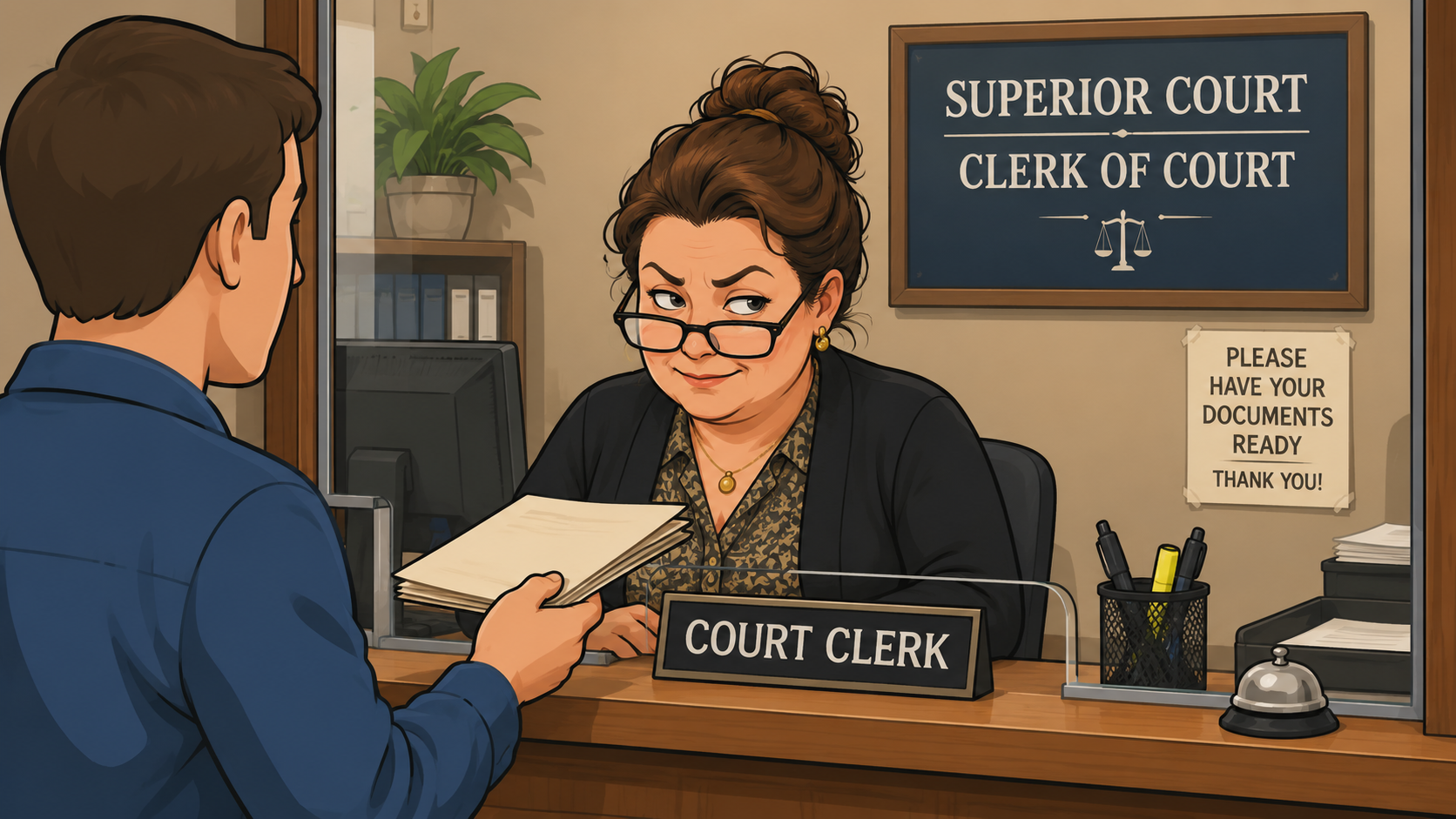
I walked into a Dauphin County courtroom on April 23 for what Judge Jeffrey B. Engle’s orders called “oral argument.” That label mattered. Oral argument means legal argument based on the papers already filed. Oral argument does not mean witnesses. Oral argument does not mean surprise exhibits. Oral argument does not mean a trial-like hearing. I said exactly that at the outset, objecting that the April 7 orders set oral argument, not a hearing with witnesses and exhibits. Judge Engle initially agreed that the hearing would be confined to the filed matters.
Then the hearing changed. The Dauphin County Tax Claim Bureau’s solicitor, Ryan Gonder, announced that the Bureau had about 20 exhibits and intended to call Holly Martz, a Bureau official, to explain how the Bureau handled tax-sale notices. I had not received any order saying witnesses or exhibits would be used. I had no witness list, no advance copies of the documents the Bureau planned to use, and no notice that the Bureau would try to build a court record through testimony and exhibits. I objected to that lack of notice. Judge Engle gave me only a short recess to review the Bureau’s materials. Judge Engle then allowed the Bureau to proceed with testimony and exhibits. That is the heart of the problem.
A tax sale is one of the most serious powers local government can use. A tax sale can take real property without the owner’s consent. Pennsylvania’s Real Estate Tax Sale Law therefore requires the Bureau to follow every required step before the sale, before the court approves the sale, and before title changes hands. Those safeguards appear in 72 P.S. § 5860.601, “Date of sale”; 72 P.S. § 5860.602, “Notice of sale”; 72 P.S. § 5860.607a, “Additional notification efforts”; and 72 P.S. § 5860.607, “Bureau’s consolidated return to court.” Those rules are not technicalities. Those rules are the safeguard between lawful tax collection and confiscation.
I challenged the September 25, 2025 tax sale of my Harrisburg property, sale entry (-31), on Dauphin County upset-sale docket 2025-CV-06173. I argued that the Bureau sent notices to wrong or stale addresses, failed to send pre-sale notice to my known residence address, and later sent a post-sale notice that identified the wrong property address. The hearing testimony did not cure those defects. The testimony confirmed the defects. Bureau’s own evidence showed that the pre-sale notice of sale went to a discontinued P.O. Box, not my residence. The Bureau did not send pre-sale notice to my residence. The Bureau’s post-sale notice misidentified the property sold. The law was not uncertain. George v. Delaware County Tax Claim Bureau and Metropolitan Properties v. Dauphin County Tax Claim Bureau held that returned mail requires further efforts to locate and notify the owner, that newspaper notice does not replace those efforts, and that the Bureau must perform and prove the required search. I put both cases before the same court and Bureau counsel before the April 23 hearing.
Judge Engle nevertheless questioned me about tax bills, payment history, property postings, newspaper notice, tenant contact, and property-management practices. Bureau counsel then asked whether I would agree to pay taxes as a condition of getting my property back. Those questions shifted the hearing away from the Bureau’s legal burden and toward blame on the owner. Section 607(d) does not allow that shift. RETSL objections may question the regularity or legality of the Bureau’s proceedings in respect to the sale. RETSL objections may not become litigation over tax liability, the tax collector’s return, or the claim entered. The only lawful question was whether the Bureau complied with the mandatory sale procedures before the sale. Owner conduct could not cure Bureau noncompliance.
The April 27 order then made the surprise hearing record operative. After allowing the Bureau to build an evidentiary record at a proceeding noticed only as oral argument, the court ordered proposed findings of fact and conclusions of law based on the April 23 exhibits and testimony. The order treated the surprise record as the record used to decide the case. On May 20, Judge Engle issued an order declaring the September 25, 2025 sale invalid and set aside. The order also declared any tax-sale deed void ab initio and directed the Bureau to restore title to the pre-sale status. That result confirmed the core point: the sale could not stand. But even that order did not fully track Section 607(e). Section 607(e) says that if objections are sustained and the defect is not amendable, the court shall invalidate the sale and order another sale to be held in conformity with RETSL at the time and under the conditions fixed by the court. Judge Engle’s order invalidated the sale, but did not order another RETSL-compliant sale. That omission matters because the Bureau cannot treat an incomplete order as open-ended authority to restart sale machinery on its own.
Other cases from the same 2025 Dauphin County tax-sale docket raise the stakes because they show more than one pressure point. The Williams/Brown case shows the same procedural pathway appearing again. Another set of owners challenged the sale of 855 Sand Hill Road in Hershey, sale entry (-4) on the same September 25, 2025 docket. The court ordered the Bureau to respond. The Bureau filed a short denial-based answer verified by Holly Martz. Judge Engle then scheduled the matter for “oral argument,” not a hearing with witnesses and exhibits. The Williams/Brown docket shows the same Bureau, same solicitor, same Martz verification, same judge, same sale docket, same court-response process, and another oral-argument order. In plain terms, the concern is not just that one hearing went wrong. The concern is that the same procedural setup may be appearing when other owners challenge sales from the same docket.
A second pattern appears in cases that ended through payment-conditioned stipulations. In Martin/Grid, sale entry (-8), and Griffin/Britton/Grid, sale entry (-30), owners challenged tax sales from the same docket. The parties used stipulations to set aside the sales, but the stipulations made invalidation conditional. The owners had to pay money to the Bureau and Grid Investments. If the owners failed to pay, the Bureau or Grid could seek confirmation of the same sales, the owners would waive objections, and the owners could face attorney fees and costs. That matters because Section 607 draws a hard statutory line. Objections may test the regularity or legality of the Bureau’s sale proceedings; objections may not become litigation over tax liability. If objections are sustained and the defect is not amendable, Section 607(e) requires invalidation and any next sale must proceed in conformity with RETSL. That is the remedy the General Assembly wrote. A court or stipulation may not replace that remedy with payment conditions, purchaser reimbursement, objection waivers, or confirmation of the same defective sale. If the sale is invalid, the statutory remedy is RETSL invalidation—not a forced buyback.
The scale matters. The September 25, 2025 Dauphin County upset sale listed 32 sale entries across Dauphin County and may involve at least 33 parcels. The point is that multiple challenges from the same sale cycle now reveal one systemic danger: a strict statutory safeguard is being converted into a pressure system. Instead of deciding whether the Bureau proved lawful sale compliance, the process drifts toward surprise evidence, owner-fault questioning, incomplete Section 607(e) remedies, and payment-conditioned settlements. That drift matters because tax-sale cases are not ordinary collection disputes. The Bureau is asking the court to approve the permanent loss of real property. RETSL exists to restrain that power. If the court process helps the Bureau build after-the-fact records, pressure owners into payment, or bypass the statute’s remedy, the safeguard has failed.
The serious question is whether these events are isolated mistakes, or whether the court process is being used in a repeatable way that helps the Bureau preserve defective sales, pressure owners into payment-conditioned settlements, or build after-the-fact records under the cover of “oral argument” orders. The constitutional danger is plain. Pennsylvania’s Declaration of Rights protects property and guarantees open courts and fair legal process. Those guarantees are threatened when an owner prepares for legal argument on filed papers, the Bureau arrives ready to build a factual record, and the court permits surprise exhibits, live testimony, owner-fault questioning, payment leverage, and trial-style written submissions without advance notice. That is trial by ambush. In a tax-sale case, the result can be permanent loss of real property.
The fix is not complicated. Courts must keep RETSL inside RETSL. Oral argument must remain oral argument. If the Bureau wants witnesses or exhibits, the court must say so in advance. The order must define the issues, identify witnesses, require exhibit exchange, and give owners meaningful time to prepare. The Bureau must prove compliance from its required sale records. RETSL does not permit courts to save defective tax sales through after-the-fact testimony, owner-fault questioning, payment conditions, or informal settlement machinery. If the Bureau cannot prove that required notice steps occurred when the law required those steps to occur, the sale must be invalidated. The full September 25, 2025 sale docket should be reviewed. That review should include returned mail, defective notice records, challenged sales, payment-conditioned stipulations, incomplete statutory remedies, and proceedings scheduled as “oral argument.” The Williams/Brown hearing should be monitored and transcribed because the same procedural pathway appears to be recurring.
The deeper fix belongs with the General Assembly. Pennsylvania should create a legitimate and transparent funding mechanism for municipalities. Local services need funding, but public finance should not depend on fear, leverage, surprise procedure, and forced loss of homes. A free Commonwealth should fund government without turning homeowners into revenue targets. No property owner should lose title through a proceeding labeled “oral argument” but conducted like trial. No property owner should have to buy back the right to undo an unlawful sale. The rule should be simple: strict compliance or no sale. No surprise hearing. No owner-blame substitute. No forced buyback. No resale machinery without a lawful order. No property loss outside the statute.
Source note: This article is based on public docket materials from Dauphin County Court of Common Pleas case No. 2025-CV-06173, including court orders, hearing transcript excerpts, Tax Claim Bureau filings, stipulations, and Pennsylvania Commonwealth Court decisions discussed above.
Appreciate what you’re reading? Be sure to share it!
Have a story? Break it at LibertyLens.News! Become a Contributor.
Support platforms, like The Liberty Lens, that enable independent grassroots journalism. Donate here.